Wednesday, February 20, 2013

Understanding the Concept of the Volume of a Rectangular Prism

Today I did an awesome activity with my 6th graders to help them to understand the concept of volume. Not only did the kids enjoy this lesson, but they also came up with some amazing answers to the questions that were asked. This was a great higher level thinking activity that I believe could be applied to other grades that you might teach.

(If you are interested in getting a copy of this lesson plan along with the prism template, please visit my TpT site to see if you may want to download it.)

First, students cut out the foldable pictured below. They are then instructed to tape the sides together to form a prism.


Next, I asked my students to tell me how many cubes they thought were inside of the whole prism. They got to work trying to figure this out. I had one student out of the 45 sixth graders that I teach come up with an excellent answer.
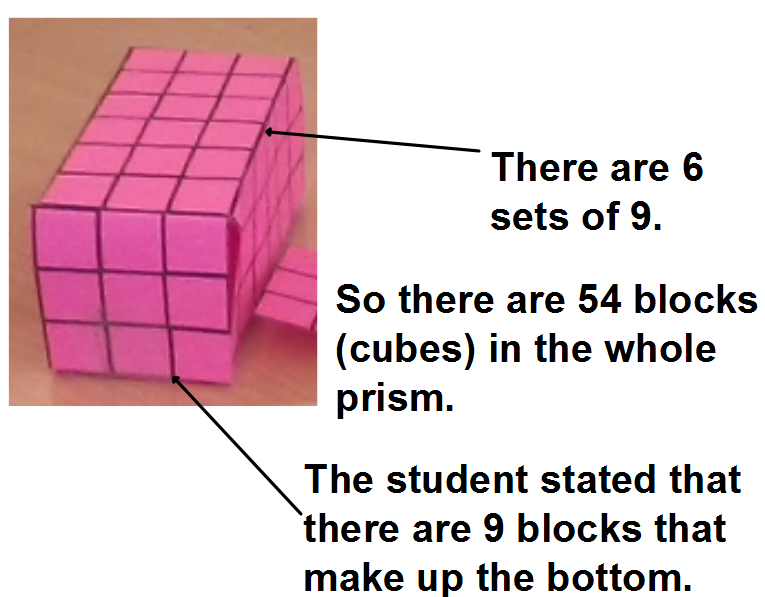

I had this student come up and explain this. He came to this conclusion with NO HELP from me! I love when this happens!!!!

The next question that I posed was what if two of these prisms were stacked up together? What would be the number of cubes inside? (Oh yeah, and I told the students they had to forget that the answer to the last question was 54 cubes and start the process from scratch.)


Here is one example of what they came up with. (We derived the formula together. As a class we determined that volume is equal to the area of the base (B) multiplied by the height.)

Then I had them situate the blocks so that they made a wider prism. Would they get the same volume? They had to prove it.


Here  is an example of what one student came up with.


Friday, February 15, 2013

Common Core Ratios Flipbook Was a Success

The Common Core Flipbook really worked to help demonstrate the concept of ratios. Here is a sample of one that as created today. It can be glued or stapled right in the students math notebooks or onto a cardstock piece of paper and hole punched to be kept in a math binder if this is what you have your students use for notes. I forsee this being an excellent resource for my students as we get closer to beginning our Ratio Unit.
You can find it here:
http://www.teacherspayteachers.com/Product/Common-Core-Concept-of-Ratios-Flipbook


Thursday, February 14, 2013

Betta Math's Common Core Flipbook for Ratios

Hello again! I just got finished creating a new Betta Math Flipbook. The last one was so popular, I decided to see how this one would do on the TpT site. In the tradition of trying to transition into the COMMON CORE, I feel that students need to take ownership of the concepts they are learning. It needs to be an interactive, fun process especially for the middle school level. I am so excited to be putting this book together tomorrow with my students. I will be posting examples of what my students come up with in the days to come, but in the mean time here is a picture of the PDF document. You can find this interactive flipbook at my TpT site: http://www.teacherspayteachers.com/Product/Common-Core-Concept-of-Ratios-Flipbook

I hope that you will choose to try this resource out and I would love the feedback from my fellow professionals...because frankly, your opinions are the most important!


Images: New Betta Math Flipbook on Ratios

Tuesday, February 12, 2013

Ratios and Proportional Reasoning the Common Core Way!

As we approach our state testing, I am ready to get this test over with and am so excited to get the opportunity to help my students explore a deeper understanding of the math concepts that we have traditionally had to fly through due to the nature of our MSA multiple choice/BCR response test. (If you teach in Maryland, you understand all of those lovely abbreviations and if you do not teach in Maryland, I am confident that you have some sort of standardized test that has really dumbed down the subject you love beyond recognition...) Blah, blah blah... What it all boils down to is that students are going to have to be challenged on their own level and we are going to be expected to show that we are helping students to authenitcally learn concepts, while creating lessons that engage them at their individual level...oh yeah AND helping them to grow during the time you work with them. I don't know about you, but I have my moments where I wonder how I will do this successfully. This SCREAMS student portfolios. I know that is what most middle school teachers do not want to hear. We teach on average 80 or more students each year and it is a scary thought to think how this can be managed.

I am in the process of putting some of my ideas ideas into practice. How can this can be done effectively? This blog will serve two purposes. The first will be to help me to reflect upon my transition into the Common Core Curriculum and evaluate my effectiveness as a teacher/coach in this role. It will also serve as a place where I can share what I have done, and how I feel I can improve upon the practices I am implementing. I hope that you will visit my blog and read about some of the things that have worked and some of the ways I will be improving things that did not work. Here are just a few ideas that I will be using in my class. My overall unit is going a little more slowly than anticipated due to the amount of MSA preparation I have been creating to help my students. This Ratio and Proportional Reasoning Unit is coming along slowly, but I am also hoping to really find ways to help my students own their learning. Here is a sneak peak of what I am creating for my class.
This is a DOMINOE ACTIVITY that students will organize in their
notebooks to demonstrate their knowledge of ratios.

This investigation lets students visually see various ratios
of food coloring to water. How intense is the color?
What makes the color more intense/ less intense?


Thursday, January 31, 2013

Betta Math Effective Strategies for Teaching Fraction

I had grappled with teaching fractions before thinking about the methods that I now use in my class. I start with the MAGIC ONE. The MAGIC ONE shows students how to make equivalent fractions. The lesson that accompanies this can be downloaded from the e-book entitled Betta Math's Survival Guide for Teaching Fractions at: http://www.teacherspayteachers.com/Product/Betta-Maths-Survival-Guide-Teaching-How-to-Add-and-Subtract-Fractions

The video shown below can be downloaded in 2 parts at the following links.

http://www.teacherspayteachers.com/Product/Part-1_Introduction-to-the-Magic-One-Supplementary-Video

http://www.teacherspayteachers.com/Product/Part-2_Introduction-to-the-Magic-One-Supplementary-Video


Sunday, January 27, 2013

Ratios and Proportional Reasoning Unit Plan for Common Core

    I am in the process of putting together a comprehensive unit for the RATIOS and PROPORTIONAL REASONING common core standard. I am currently putting it together and should have it completed by the end of this week.
     It will include a pre-assessment, mid-unit assessments, post-assessment, tiered workbooks at three different levels for the student that needs to begin learning the very basics of RATIOS to students that are ready for more challenging work dealing with RATIOS, TAPE DIAGRAMS and UNIT RATES. It will also include some project ideas for you advnaced students.
    To help you determine where to place each student, I have completed student tracker cards that will help you decide where each student needs to start.
   I am very excited to be working on this new project and feel it will be a great resource!

Preview of Upcoming Unit


Friday, January 25, 2013

A Great Way to Help Students Discover the Sum of the Interior Angles in Polygons!

Hello again, I thought I would share another great discovery lesson that worked really well! I completed this lesson Wednesday with my 7th grade students and it was very successful. In order to get my students to understand the concept of finding the missing angles of various polygons, I started with a short activity dealing with triangles. It is not a new idea, and I do not take credit for it, but it was a great starting point for this lesson. This lesson would be very easy for you to recreate on your own, however if you want the pre-made UBD Lesson Plan and all necessary templates, you can look for it at my TpT store at: http://www.teacherspayteachers.com/Product/Betta-Math-Discovery-Lesson-Finding-the-Sum-of-Interior-Angles-of-Polygons

Once the students have finished discovering that ALL triangles have three angles that add up to 180 degrees, they then investigate how many triangles are in each polygon. I created a quadrilateral, pentagon, hexagon, haxagon, heptagon, and octagon for them to investigate. They should arrive at teh conclusion that there is a pattern. The number of sides a polygon has minus 2 equals the number of triangles. They know that a triangle equals 180 degrees, so to figure out the sum of the interior angles, you just multiply the number of triangles by 180 degrees.
Students started with a random triangle that they cut out. They
labled and highlighted each angle.