I just realized the sad fact that it has been since August that I wrote my last blog. Shame on me! I have decided to fill you (the reader) in on what I have been doing in my classroom.
First, I must say that while I loved being a regular classroom 6th grade teacher and never thought I would be able to top this position, I believe that I actually have found a position I enjoy even more. This is my first year as the Math Enrichment teacher at my school and I absolutely love it! I am basically a math coach and I work with both 6th and 7th grade students who have some trouble with various math concepts. My job is to pinpoint where the students are struggling with concepts that parallel what is being taught in their regular education math class. It is like a puzzle because different kids are at different places and require specialized help. They have diverse learning styles and I have the privilege of working with most of the school population to help them become stronger in math. Taking time to reflect upon this experience now that I am three-fourths of the way through this year, I really have found it rewarding to have the opportunity to look work closely with the students to determine exactly where they got off track with the concept that are being studied and then build them back up from that misconception to see them grow and become more confident in their ability to understand math.
This is also a position that requires me to be a floating teacher. I actually like being on the cart (crazy right?) because it helps me to be a stronger teacher. I will be posting some tricks of the trade that I have learned wheeling my cart around the school. If you are also a floating teacher, I hope you will check back in to read about my positive experiences as a floating teacher.
Tuesday, March 10, 2015

Sunday, August 31, 2014
Making Sense Out of Multiplication...
 It seems as though the longer I teach, the more it seems that students just really have difficulty using the multiplication algorithm. When I started to see this more often a few years back, I began to implement the "matrix" or "grilled cheese" method of multiplication. Kids still had trouble with this. It seemed as though this was just a skill that the kids just have to learn. Recently, however, I began to think about how this skill could be learned differently. My students seemed to be pros at multiplying various numbers by a one digit number. I am sure someone else has thought of this before, so I am in no way taking credit for multiplying this way... but when I implemented this method into my Math Enrichment class I saw the light bulbs turn on and it was so exciting that I just had to write this blog. So if you have beat the traditional multiplication algorithm into the ground and are still having students struggle with multiplying, you may want to give this a try. (Bonus: this also shows a real use for the Distributive Property!)
I started my lesson off with some really simple problems involving mental math.

This was to help the students to start thinking about instances where it is easy to use mental math.
Next, I introduced the idea of breaking up a multiplication problem on the following manner.

By breaking up the first part of the product in this way, the student will ultimately have two very easy multiplication problems to evaluate...

What is nice about this method is that once the second number in the multiplication problem is distributed, the student has two problems involving a number multiplied by a single digit number. This eliminates the need to remember the steps that are involved in multiplying by a two digit number and allows students to utilize some mental math, which makes the whole process much quicker.

Finally, the student just has to add both of the products of the two problems that they completed and they have the product of the original problem. My students (even though they tend to struggle with remembering how to multiply) do very well with this method. The ones that were pretty good with the traditional algorithm, find that this way helps them to multiply more quickly, so they also like using it. I hope you will try this with your students! It has done wonders for mine.
I will be posting more about this in days to come. Thanks for reading and Happy Teaching!
Friday, April 11, 2014
Applying Plotting Ordered Pairs: Mathica Monster Activity
 |
| Mathica Monster |
This lesson really helped students to understand the concept of distance between points on a coordinate plane and to apply graphing ordered pairs in relationship to other positions. Even though this year has been tough because we are transitioning to a new and more deep curriculum, I have seen some positive strides over the course of the year from when I first started working with my students to now. It takes time to help students learn how to apply math rather than merely complete basic skills. I am excited to see how I can grow as a teacher and how my students in the future will benefit from going deeper into the math concepts. This blog is my way of reflecting and sharing my ideas of what works with my fellow educators. This was definitely a lesson that I felt enriched the students' understanding of this concept. This lesson can be found at my TpT store for FREE please stop by and browse some of my other resources. If you like what you see please FOLLOW ME.
Here is a video preview of the Mathica Monster Lesson. Thanks for stopping by and I hope you come back!
Saturday, April 5, 2014
Reflecting Ordered Pairs Across the Axes: A Hands On Activity Using Mirrors
It has been a while since I have written a blog entry. (Snow days and state testing has backed a lot of my lesson planning up). I am very excited to write about a recent lesson that I completed with my students that involved reflecting across the x and y-axis.
In this lesson, students discovered the mathematical patterns behind reflecting ordered pairs and collections of ordered pairs across the x-axis and y-axis. The students used mirrors to help them see what was happening. It was a lot of fun watching them discover this and it was rewarding to even see my lower ability classes coming up with some amazing observations. (View the video to see this lesson in action.)


![]()

In this lesson, students discovered the mathematical patterns behind reflecting ordered pairs and collections of ordered pairs across the x-axis and y-axis. The students used mirrors to help them see what was happening. It was a lot of fun watching them discover this and it was rewarding to even see my lower ability classes coming up with some amazing observations. (View the video to see this lesson in action.)
Students started out with a short video showing them how to use the mirrors to reflect across each axis.
Here are some glimpses of some of the notes sheets that were featured in the above video.
A similar lesson to this would not be difficult to create, however if you like what you see on this blog, the lesson is available at my TpT site and can be viewed here. Thank you for taking time to view this lesson, it was very fun to teach and the students got a very good understanding of it.
Friday, January 24, 2014
Teaching the Concept of Dividing Fractions to Middle Schoolers Can Be Done Successfully!
At the end of a few beautiful and restful snow days, I am getting ready to go back to work today. (It has always been a well known fact that teachers enjoy getting those calls more than the kids do!) Having a little extra time off has given me time to spruce up my dividing fractions unit and take what I did (which worked really well with my 6th graders) and share some of my thoughts with you about what I think is the best way to develop this concept in the classroom.
Here was the sequence of discovery lessons that I wrote to help guide my students to this conclusion.
If this looks like something you may be interested in using in your class, you can find this lesson on my TpT website: http://www.teacherspayteachers.com/Product/Betta-Maths-Survival-Guide-to-Multiplying-and-Dividing-Fractions-1076050.
This lesson has really helped my students to truly understand how to divide fractions and they can also explain why the algorithm works.

Some of my students were able to then progress from the template shown above to merely multiplying the first fraction in the division problem by the reciprocal. (I allow them to do this if they discover this on their own.)
Thank you for visiting my blog. I should be writing some more soon!
Sincerely,

Common Core Does NOT Mean that the Algorithm Has to Be Thrown Out the Window...
I have listened to various professional opinions in regard to this misconception about the Common Core Curriculum. The goal of this approach to math is that the students become better at mathematical reasoning. When teaching this concept, I took the approach that I wanted the students to discover as much as they possibly could on their own in the most visual way possible. I wanted them to truly understand each step of the algorithm before they even began using it. Why do algorithms even exist? This is the question I want my kids to understand, not just tell them to "Do these steps and you will get the correct answer." Algorithms are a result of looking at numerous problems visually to see if you notice any patterns. If something is noticed over and over again about a certain type of math problem, this pattern can be used to create a set of rule (algorithms) that work no matter what. I tell my students that usually the algorithm is a short cut that is a result of much research.Here was the sequence of discovery lessons that I wrote to help guide my students to this conclusion.
Sequence of Lessons:
Pre-requisite Skill: Multiplying Fractions Students will learn what is really happening when two values are being multiplied together. This will help them to understand why you multiply the numerators together to get the new numerator and why you multiply the two denominators together to get the new denominator.
Lesson Includes:
•Fully typed out UBD lesson plan and Teacher Notes
•Power Point and all Instructional Videos
•Accompanying Student Notes Sheet
•Practice Worksheets
Lesson 1: Introduction to Dividing Students will first manipulate counter chips to better understand what they are doing when they are dividing. Students will then manipulate fraction bars either by using a fraction bar manipulative website (or by using the attached templates that students can cut out if access to computers is not possible) to also discover what happens when you divide a whole number by a fraction. Students will begin to discover a pattern when they divide a whole number by a fraction.
Lesson Includes:
•Fully typed out UBD lesson plan and Teacher Notes
•Power Point and all Instructional Videos
•Accompanying Student Notes Sheet
•Practice Worksheets
Lesson 2: What is a reciprocal? Students will once again use the fraction bar manipulative website to understand what a reciprocal is. They will discover that a reciprocal is what you can multiply a fraction by in order to make a MAGIC ONE©.
Lesson Includes:
•Fully typed out UBD lesson plan and Teacher Notes
•Power Point and all Instructional Videos
•Accompanying Student Notes Sheet
•Practice Worksheets
Lesson 3: Learning Why the Dividing Fractions Algorithm Works.
In this lesson students will use what they discovered in the previous lessons to recognize patterns. Through this understanding they will work through a template that they will be able to describe in detail to better ultimately better understand the algorithm.
Lesson Includes:
•Fully typed out UBD lesson plan and Teacher Notes
•Power Point and all Instructional Videos
•Accompanying Student Notes Sheet
•Practice Worksheets
Pre-requisite Skill: Multiplying Fractions Students will learn what is really happening when two values are being multiplied together. This will help them to understand why you multiply the numerators together to get the new numerator and why you multiply the two denominators together to get the new denominator.
Lesson Includes:
•Fully typed out UBD lesson plan and Teacher Notes
•Power Point and all Instructional Videos
•Accompanying Student Notes Sheet
•Practice Worksheets
Lesson 1: Introduction to Dividing Students will first manipulate counter chips to better understand what they are doing when they are dividing. Students will then manipulate fraction bars either by using a fraction bar manipulative website (or by using the attached templates that students can cut out if access to computers is not possible) to also discover what happens when you divide a whole number by a fraction. Students will begin to discover a pattern when they divide a whole number by a fraction.
Lesson Includes:
•Fully typed out UBD lesson plan and Teacher Notes
•Power Point and all Instructional Videos
•Accompanying Student Notes Sheet
•Practice Worksheets
Lesson 2: What is a reciprocal? Students will once again use the fraction bar manipulative website to understand what a reciprocal is. They will discover that a reciprocal is what you can multiply a fraction by in order to make a MAGIC ONE©.
Lesson Includes:
•Fully typed out UBD lesson plan and Teacher Notes
•Power Point and all Instructional Videos
•Accompanying Student Notes Sheet
•Practice Worksheets
Lesson 3: Learning Why the Dividing Fractions Algorithm Works.
In this lesson students will use what they discovered in the previous lessons to recognize patterns. Through this understanding they will work through a template that they will be able to describe in detail to better ultimately better understand the algorithm.
Lesson Includes:
•Fully typed out UBD lesson plan and Teacher Notes
•Power Point and all Instructional Videos
•Accompanying Student Notes Sheet
•Practice Worksheets
If this looks like something you may be interested in using in your class, you can find this lesson on my TpT website: http://www.teacherspayteachers.com/Product/Betta-Maths-Survival-Guide-to-Multiplying-and-Dividing-Fractions-1076050.
This lesson has really helped my students to truly understand how to divide fractions and they can also explain why the algorithm works.
Some of my students were able to then progress from the template shown above to merely multiplying the first fraction in the division problem by the reciprocal. (I allow them to do this if they discover this on their own.)
Thank you for visiting my blog. I should be writing some more soon!
Sincerely,
Monday, December 23, 2013
A Common Core Conceptual Approach to Explaining the Distributive Property
Hello. It has been a while since I have blogged, but I had to inform you about a great way for students to discover the distributive property. This property is a vital part of algebra and students need it as a bulding block to understand such topics as "FOIL" and finding common factors.
In this lesson, students must manipulate rectangles (representing variable terms) and squares (representing constant terms) to show that the distributive property is basically stating that the number on the outside of the parenthesis determines how many groups of the value on the inside of the parenthesis are needed to simplify the expression.
This lesson worked very nicely to help my students discover the DISTRIBUTIVE PROPERTY on their own and really helped them to make sense of how to apply the property. I love it when discovery lessons work like they are intended to!!! The students retain so much more if they can make sense of it on their own. If you are interested in obtaining this lesson please visit my TpT store!
 |
| Students begin by exploring what it means to have a certain number of groups of an expression within a parenthesis. |
 |
| Fully typed out UBD lesson plan is included with purchase. Merely print out the document and have on hand for those surprise evaluations. |
 |
| All answers for Warm-up, Practice problems and assessment question are included. |
Saturday, September 21, 2013
Today I Attended an Inspirational Teacher's Workshop with Dan Meyer
I know, a workshop on a Saturday that I did not even get paid for... crazy right? In my 10 years of teaching this was probably one of the best sessions that I attended. I urge you if you have not read about Dan Meyer and his educational message, that you take some time to do so!
I have so many ideas about how to better my lessons. The three questions that I came away with that I plan to ask myself from now on to help bring meaning to my lessons are:
There are also a great deal of FREE resources that he shared with us. These resources can be used at teh teacher's discretion and really motivated me that concepts can be introduced effectively without laboring for hours on creating videos or scenarios up out of thin air. You can use what is already available as a "jumping board" to help you introduce the concepts you are beginning to teach students. Amazing!
I cannot wait to start using some of the following resources in my classroom. The following was one resource I really appreciated having access to and wanted to pass onto my readers.
THREE ACT LESSONS - also from Dan Meyer.
ACT I - basically the idea is to draw the students in by showing them a video clip or picture that sparks their attention. (Keep the math out of it).
ACT II - Ask them the math question and have them investigate it more. Give them tools or insturction as they need it.
ACT III- Validate the answers they arrived at, let them see the various ways that the asnwer was found.
He also acknowledges that this is the "hook" but that students still need to practice problems in class and at home in order to master the skill.
I am planning on incorporating this with my 6th graders and was very excited to have the oppurtunity to attend this workshop. Have a great weekend!

I have so many ideas about how to better my lessons. The three questions that I came away with that I plan to ask myself from now on to help bring meaning to my lessons are:
 |
| Questions I have learned to ask effectively. From Dan Meyer's workshop. |
There are also a great deal of FREE resources that he shared with us. These resources can be used at teh teacher's discretion and really motivated me that concepts can be introduced effectively without laboring for hours on creating videos or scenarios up out of thin air. You can use what is already available as a "jumping board" to help you introduce the concepts you are beginning to teach students. Amazing!
I cannot wait to start using some of the following resources in my classroom. The following was one resource I really appreciated having access to and wanted to pass onto my readers.
THREE ACT LESSONS - also from Dan Meyer.
ACT I - basically the idea is to draw the students in by showing them a video clip or picture that sparks their attention. (Keep the math out of it).
ACT II - Ask them the math question and have them investigate it more. Give them tools or insturction as they need it.
ACT III- Validate the answers they arrived at, let them see the various ways that the asnwer was found.
He also acknowledges that this is the "hook" but that students still need to practice problems in class and at home in order to master the skill.
I am planning on incorporating this with my 6th graders and was very excited to have the oppurtunity to attend this workshop. Have a great weekend!
Sunday, September 15, 2013
Interactive Lesson on Relating Ratios to their Proportionate and Equivalent Forms
This lesson worked really well last week for all levels of classes because it scaffolded the thought process needed to find equivalent ratios. Student could manipulate the shapes and were encouraged to use ratio language to make sense this concept.
The video above gives a short preview/explanation of the lesson. Our school has access to the promethean board and ActivInspire so this is a flipchart and PDF student notes file and works best when students can utilize a computer individually in a computer lab setting or laptop cart setting. (If you are someone that may want a low tech version of this lesson, please contact me through TpT by finding this product and describing to me what you would like through the "QUESTION" prompt.) You can find this lesson at my store. This lesson is aligned with CCSS 6RP1 and includes answer keys describing how the lesson should progress.
Saturday, September 7, 2013
Introducing the Concept of Rate
This week, I finished up working on helping my students to understand basic ratios through a variety of activities. Yesterday, I introduced the idea of rate by posing a challenge to my students.

It was a lot of fun to hear the different predictions. My most challenging and most active class (also at the end of the day) was really into it. They noticed right away that the race would not be fair and started throwing out phrases such as "You are trying to cheat us!". This really got them to be engaged!
Once the students had a chance to analyze both tracks, I chose a student at random (I use popscicle sticks with their names on them) to race against. I raced against four different students. The rules were that each person on each track would have to hop the distance alloted them by the post-it notes and every post-it note had to be hit. The first person to make it to their last post-it note would win. (To make it even more competitive, I taunted them a bit and kept writing the score on the board each time I beat one of them. Have fun with it!)
After I raced the four lucky students, we began to discuss the activity further. I had a few prompting questions in my mind prior to starting the discussion. (Since I want the kids to discover the idea of rate on their own, I wanted to make sure I did not give away too much information.) Students were partnered up and asked to journal their thoughts in their math notebooks as we discussed with the whole group.
I also came across some really good hands-on lessons (already made up for you) that help students work with and use unit rate at ILLUMINATIONS. I plan to use these next week as I continue introducing the concept of unit rate and its uses.
Thanks for stopping by and have a wonderful week!

Given two tracks, can anyone beat me in a hopping race???
The students were first asked to examine the two tracks and make predictions about who would win this race. (When making your two tracks it is important that the teacher's track is spaced out to cover twice the distance of the student's track.)
It was a lot of fun to hear the different predictions. My most challenging and most active class (also at the end of the day) was really into it. They noticed right away that the race would not be fair and started throwing out phrases such as "You are trying to cheat us!". This really got them to be engaged!
Once the students had a chance to analyze both tracks, I chose a student at random (I use popscicle sticks with their names on them) to race against. I raced against four different students. The rules were that each person on each track would have to hop the distance alloted them by the post-it notes and every post-it note had to be hit. The first person to make it to their last post-it note would win. (To make it even more competitive, I taunted them a bit and kept writing the score on the board each time I beat one of them. Have fun with it!)
After I raced the four lucky students, we began to discuss the activity further. I had a few prompting questions in my mind prior to starting the discussion. (Since I want the kids to discover the idea of rate on their own, I wanted to make sure I did not give away too much information.) Students were partnered up and asked to journal their thoughts in their math notebooks as we discussed with the whole group.
- Was the race fair, why or why not?
- Why was I able to win each race?
- What do you notice about my track compared to your track?
I also came across some really good hands-on lessons (already made up for you) that help students work with and use unit rate at ILLUMINATIONS. I plan to use these next week as I continue introducing the concept of unit rate and its uses.
Thanks for stopping by and have a wonderful week!
Sunday, September 1, 2013
The First Week Went Great! We Began the Ratios Unit...
We began the Ratios Unit this past week and I am excited to say that it went well. What a great start to the year, I have nice students that gave me a really good effort on the Ratios Pre-Test and I am currently completing their Student Achievement Growth Cards. (These come from my Betta Math Ratios and Proportions Unit.)
Another useful tool that I found online is a ratios worksheet generator. This can be found at MathAids and also generates the key for various topics. I use it a lot for basic skills when I may not have time to create my own worksheets.

In preparing for next week, I am going to focus on getting students to really be able to understand how to write and simplify ratios through a number of activities. I am using an adapted version of the Math Workshop that I purchased from:
 The author of the math workshop I will be using and adapting to middle school classroom has been kind enough to allow me to blog about this. I wanted to make sure I awarded her the proper credit because it has helped me organize my thoughts about encorporating math workshop in my 6th grade classroom.
I believe that this is where the curriculum is taking us and gives you the flexibility to hit numerous learning styles in one class period and promote differentiate learning.
I will also be blogging more about student portfolios and my students' interactive math notebook. Since textbooks are becoming more of a secondary reference, student notebooks are even more important to their success. Please stop back here frequently because my intention is to blog on a weekly basis and I would love any feedback any other professionals may offer.
To those of you starting back to work...have a great year!

Another useful tool that I found online is a ratios worksheet generator. This can be found at MathAids and also generates the key for various topics. I use it a lot for basic skills when I may not have time to create my own worksheets.

In preparing for next week, I am going to focus on getting students to really be able to understand how to write and simplify ratios through a number of activities. I am using an adapted version of the Math Workshop that I purchased from:

I believe that this is where the curriculum is taking us and gives you the flexibility to hit numerous learning styles in one class period and promote differentiate learning.
I will also be blogging more about student portfolios and my students' interactive math notebook. Since textbooks are becoming more of a secondary reference, student notebooks are even more important to their success. Please stop back here frequently because my intention is to blog on a weekly basis and I would love any feedback any other professionals may offer.
To those of you starting back to work...have a great year!
Tuesday, August 13, 2013
Exploring the Number Line


If this product looks like something you might be able to use in your classroom, please download it from my TpT store HERE. While you are there, please click the "follow me" link to get updates about new products from my store. Thanks for your interest and please visit my blog to see how I am implementing the Common Core Curriculum into my classroom.
Monday, July 29, 2013
Not Quite Ready for Summer to End... but Starting to Gear up for the Next School Year!
 Even though it is always a little sad to see the summer come to an end and leave the days of having all day to do things with my girls, the fact is that the summer is coming to an end in the next few weeks. Since it is inevitable, I have decided to try to be positive about this fact and begin thinking about how I want to start out the school year. As of right now, I will be teaching only 6th Grade. This excites me because I love teaching 6th Graders, they are so much fun!
  |
| Pine Cone Bees for my classroom decor. |

I am currently working on a Unit for The 6th Grade Number System Common Core State Standard and it will be finished soon! Good luck in the new year.

Saturday, April 6, 2013
Common Core Student Sample Write-ups
In an effort to help students transistion into the Common Core Curriculum, I have started working with them on how to organize their thoughts and expand upon the answers to various math problems. Here are some examples that were graded on a scale on 1-10. Students were asked to create a math write-up answering the following problem


Wednesday, April 3, 2013
Using the Math Practice Flipbook to Write about Math Tasks
My students completed their Math Practice Flipbooks yesterday. Here are some images of them creating their flipbooks.

They used them today as a resource for writing the reasoning behind the math tasks they will be working on. I created a easy level task for students to begin using this resource and the kids did so well I decided to put this on my blog :o). I will also be putting some examples once I have finished grading them. The Flipbook Template and the math task below can be downloaded at http://www.teacherspayteachers.com/Product/Common-Core-Math-Practices-Flipbook
 The students did a really nice job with this activity and came up with some really great answers. Here are some images of them working on this math task.

The students were able to use their Math Practice Flipbooks to help them write the reasoning behind these math tasks.


 |

They used them today as a resource for writing the reasoning behind the math tasks they will be working on. I created a easy level task for students to begin using this resource and the kids did so well I decided to put this on my blog :o). I will also be putting some examples once I have finished grading them. The Flipbook Template and the math task below can be downloaded at http://www.teacherspayteachers.com/Product/Common-Core-Math-Practices-Flipbook

The students were able to use their Math Practice Flipbooks to help them write the reasoning behind these math tasks.


Friday, March 29, 2013
Kid-friendly Explanation of Common Core Math Practices
As I have been waiting to implement the Common Core in my Classroom, I am realizing that my students are going to need a lot of help transitioning into these new expectations. After Easter Break, I plan to start out doing this by first having students gain a deeper understanding of the Math Practices they will be conscientously using to solve problems. If I simply gave them a copy of the online practices, they would be confused and frustrated. I have created a Flipbook for their notes that will be an easy resource to refer to when using these practices. It includes kid-friendly descriptions of each standard and will also be used as an activity to have students think about 8 different situations and decide which math practice was used in each scenario. Once we have discussed each scenario and where it fits in as a class, they will glue it on the appropriate flipbook page to serve as an example when they refer back to this resource. I will be uploading pictures of the finished products as well as some of our class discussion points once I complete this lesson with my kids next Tuesday, so please visit frequently!


Sunday, March 24, 2013
Comparing Fractions, Decimals and Percentages Flipbook
Here is a video showing how to put together the "Relating Fractions, Decimals and Percentages Flipbook. This is a great way for students to review these relationships and serves as a great resource for their notes.
Please view this video to see this Flipbook as a finished product. (My students love making these and since they have time invested in creating them they refer to them more quickly than traditional notes.)
Please view this video to see this Flipbook as a finished product. (My students love making these and since they have time invested in creating them they refer to them more quickly than traditional notes.)
Saturday, March 23, 2013
Don't Get Zapped - Integer Operations

This is a really neat idea that I saw on an elementary school teacher's blog at http://swampfrogfirstgraders.blogspot.com/2011/01/dont-get-zapped-addition-version.html
and I think it could be adapted for my middle school students.
I thought it would be a great way to practice integer operations, fraction operations or any other operational skill and could be used for an independent game idea. I would like to plan to work in a 3 station group next year. As I am planning for the Common Core Curriculum, I am taking a tip from the reading teachers and creating a three groups (Red, Green and Blue). They will be working through rotating stations. One station will always be a skill self-check station... so I believe this game would work perfectly!
Basically, you put problems on popscicle sticks and place 30 of them in a container along with two "Take another Turn" sticks, two "Give Another Player a Stick" sticks and one "Zapped" stick which means you have to put all the sticks you collected back into the container. You keep a stick if you get the problem correct. I think I will number each problem and have an answer key handy so kids can check each others' responses. The student that wins is the student who has the most sticks when their time is up at that station.
I am very excited to start working on these games, but plan to use a PRINGLES container instead since my family devours these on a regular basis.

Friday, March 22, 2013
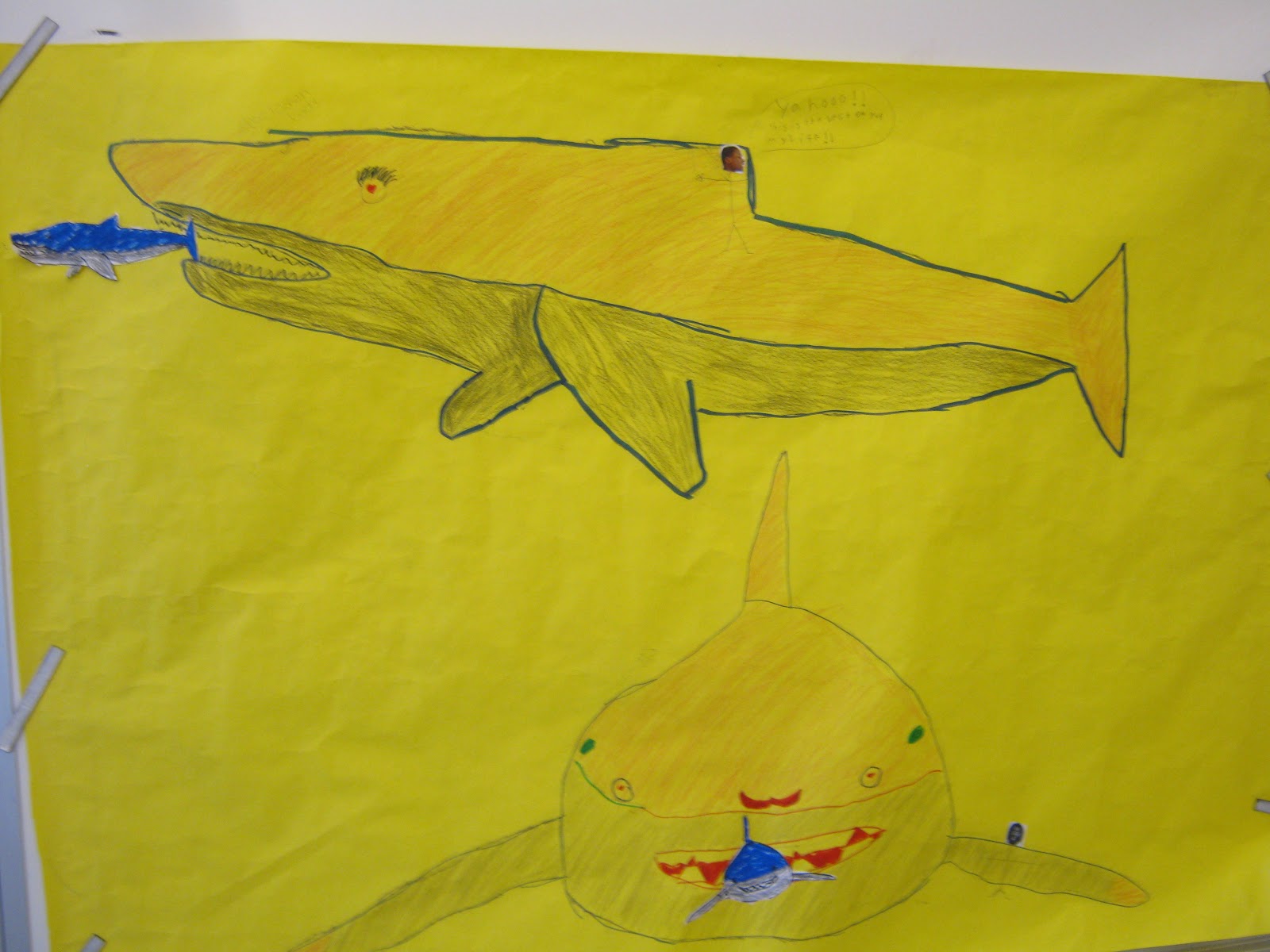
Megalodon Investigation: Work Samples

Student Work Samples: Megalodon Investigation
Even though this is a 6th Grade Unit, I had some time between State Testing and the students going on Spring Break, so I decided to try this investgation out with my 7th graders. They really did a good job so I decided to display a few of my Top Notch Groups' work with you. You can find this investigation in my Common Core Ratios and Proportions Unit or you can download just the Megalodon Investigation.


Subscribe to:
Posts (Atom)